Showing posts with label Museum Studies. Show all posts

March 17, 2014

Exploring Our World

 Back in January, we had a our annual Museum Exhibit Night (Read about previous Museum Nights here and here).  This year, the theme of our first grade exhibit was "Exploring Our World."  Through this theme, we incorporated our geography standards, field studies, and nonfiction reading unit.

Similar to last year, we created a map of the world on our shared bulletin board.  (Although this year I learned that I could use my SMART board projector to trace on to paper, making the continents much more to scale).  The kiddos labeled important geographical features, including oceans and mountain ranges.  Our sweet Art Teacher worked with each class to create 3D landmarks and topographies.


Unfortunately I forgot to take a picture of the whole exhibit so these close-ups will have to do!


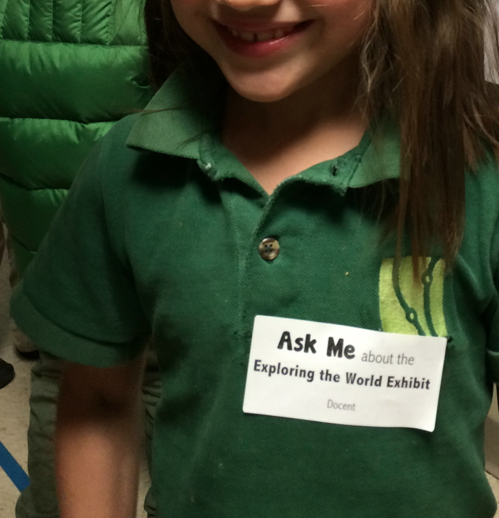
On the night of the exhibit, the kiddos got their "docent tags."  They loved hosting their friends and families around the exhibit, pointing out their details on the map and their book club posters. We managed to pull in a number of standards and skills with this project and it was obvious with all of the connections that the kiddos made as they talked about what they'd learned!


March 3, 2014

Botanic Garden Field Trip

Last week we had our school-wide Museum Night.  I have to admit that this year's exhibit was not as complete or cohesive as I would have liked.  Nevertheless, we did have some fun experiences as we prepared for our exhibit.  

One of our trips was to the National Botanic Garden.  Our goal for this trip was to connect our unit on living and nonliving things with our study of geography.  The kiddos were assigned to take pictures of plants from each of the regional areas featured at the Garden (jungle, desert, southern hemisphere, Hawaii).  Then they had to create a descriptive caption for the picture.  

We purchased some disposable cameras, but most of the chaperones also brought Smart phones or digital cameras which they let the kiddos use.  The kiddos loved being in charge of the cameras (and I got some adorable pictures of them taking pictures)!  After they had taken all their pictures, they also work with their group to answer few questions about the similarities and differences of the flowers, trees, and plants from around the world.  


If we do this trip again, however, we will need to get the pictures developed right away.  Although it was great practice for the kiddos to take a picture and write captions, by the time we actually got the pictures printed they had mostly forgotten the process.  In addition, I didn't have a totally clear idea of how we would use the pictures, so they mostly served as a resource.  Oh well.  I'll post about the final exhibit soon.

May 27, 2013

Building an Exhibit

It's time for our Spring Museum Exhibition!  Just like our fall Museum Exhibition, this school-wide open house is a way for each class to showcase their learning.  This time, the first grade is excited to share what we have learned about the ancient Maya, Inca, and Aztec civilizations.

As with our previous Museum Night project, this project is closely connected to the DC standards of learning for first grade, including:

  • Social Studies 1.4 Students describe characteristics of the of the Maya, Inca, and Aztec civilizations.
  • Social Studies 1.4.3 Explain their artistic and oral traditions, and their development of writing systems and calendars.
  • Social Studies 1.4.4 Describe the inventions and advances astronomy, mathematics, and architecture [of the ancient Maya, Inca, and Aztec people]

We planned out our display as a class and decided what topics would be most important to teach our families and friends about the Maya, Inca, and Aztecs. The kiddos worked in pairs or small groups to make posters about the most significant developments, advances, and adaptations that we had discussed.  Then we put together a detailed bulletin board that connected each poster to part of the Mesoamerican landscape.

Here's how we did it: 

We started the bulletin board by using large construction paper to create a backdrop with water, fields, hills, and a temple pyramid.

Then the kiddos created texture and add details: they dipped Q-tips in green and yellow paint to make corn for the hill tops; they layered tissue paper to build rocks, leaves, and dirt on the terraces; they sponge painted with cotton balls to create a stone facade on the temple. 


Terrace Farming "Close-up"

Then we used strings to link the posters to specific objects on the board. 


Poster about the importance of stars to the Maya, Inca, and Aztecs

Our final touch will be putting our version of "floating gardens" next to the bulletin board to demonstrate how the Aztec people grew their crops in water.  (See post about building our floating gardens).

The kiddos are ready show off how much they have experienced and learned about these ancient civilizations!

Aztec Floating Gardens

As part of our study of the ancient Maya, Inca, and Aztec civilizations, we learned how each of these groups adapted to their climate and landscape to grow (mostly) corn, beans, and squash.  We discovered that the Maya created "terraces" in the hills to capture rain water and used cenotes, or natural sinkhole, to irrigate their fields.  The Inca cultivated potatoes and were the first culture to use "freeze drying" to keep crops through the winter. And the Aztec developed "floating gardens," or chinampas, to grow crops in shallow water by building up small plots of land on wooden lattices.

Throughout this lesson, I emphasized a few important vocabulary words:

  • Maize - corn
  • Crops - food grown by people
  • Fertile - able to grow things 

The kiddos were very interested in all the different ways that people used the land to survive.  As a culmination of this unit learning, and also a fun hands-on exploration, we decided to build and plant our own "floating gardens." Of course, we used popsicle sticks and cheese cloth instead of wooden stakes, mud, and sediment, but generally the kiddos got to experience planting beans and watching them grow in standing water.

We are planning to use our floating gardens as part of our Museum Exhibit on the Maya, Inca, and Aztec civilizations.


Building our floating garden

Planting Bean Seeds

May 25, 2013

Mayas, Incas, and Aztecs, Oh My!

For the past couple of months, we have been exploring the ancient civilizations of the Maya, Inca, and Aztec people.  Our DC Social Studies Standards indicate that first grade students should be able to, "Describe the characteristics of the Maya, Inca, and Aztec civilizations," including developing an understanding of their class structures, religious traditions, artistic and oral traditions, writing systems, and advances in astronomy, mathematics, and architecture.  It's a lot to cover and process for six-year-olds but we've been doing our best!

BrainPopJr.com
I began this unit by focusing on the Maya and using one of my favorite teaching tools: BrainPop Jr.!
(BrainPopJr.com has great animated videos on a variety of topics and the kiddos love them!)  We watched the Maya Civilization video and found out that archeologists have studied artifacts and ruins in Mesoamerica to learn about the ancient Maya. We also learned that the Mayans built pyramids and used hieroglyphics to communicate.  Some of the kiddos had heard of pyramids and hieroglyphics from Egypt, but interested to find out that other societies had them as well.

I planned various lessons to explore the different advances that the Maya people had made in writing, math, and astronomy:

  • We watched a YouTube video of a calligrapher and Maya expert writing names in Mayan hieroglyphics and then the kiddos got to try to translate their own name into Mayan glyphs.  
  • We learned how the Mayans did math, using symbols of sticks and shells and the kiddos got to solve math problems using Maya Math.
  • We looked at photographs and artifacts (donated by a parent) of ancient Maya temples and calendars.
  • We read fiction and nonfiction books about the Ancient Maya.  We used a series of nonfiction books called "True Books" and also picture books such as Rain Player, an original folktale inspired by ancient Maya culture.

We are currently preparing for our Spring "Museum Night" where we will showcase our learning about the ancient civilizations.  The kiddos are very excited to share with the families and friends all the information they have learned.  More on that to come...

January 31, 2013

Night at the {First Grade} Museum

Last night was Museum Night!  Around the school, the excitement was palpable among the teachers and kiddos.  After working for weeks, and often months, Museum Night is the celebration of a lot of preparing, learning, designing, writing, and producing.


However, it was not a night off for the kiddos!  When they arrived at our exhibit that evening, I handed them their official docent name tags, which read, "My name is ______, Ask me about ______."  Under "Ask me about," I had filled in the names of the different locations that they had written about for our map project.  (Mine said "Ask me about Nothing! haha)

The kiddos were extremely proud of their stickers.  They stood near the exhibit and eagerly told their parents, siblings, and neighbors about the animals they had created, the labels they had written, and the learning webs they had drawn.  As a class, we had prepared and practiced answers for common questions like, "What are the continents?", "What is an ocean?," and "How did you make your animals?"  (I had also sent an email to parents encouraging them to ask these and other questions to get the kiddos talking).

The families seemed very pleased with the learning and creative work our kiddos had done.  A few parents even said they were learning new things!  Almost no one who finished high school after before 2001 had heard of the Southern Ocean (which was first designated an ocean in the year 2000).

Although many of the kiddos stayed in our end of the hallway for most of the evening, they also got to tour the school to see the exhibits in all the other classrooms.  It was wonderful to have former students come up with their Docent name-tags and invite me to come see their imaginary class community or the cityscapes they had sculpted.   I didn't make it to every classroom last night, but, fortunately, got to see most of the exhibits in the hallways when I got to school this morning.

We will probably keep our map up for another week before we take it down to make room for the next celebration of learning :)

January 30, 2013

First Grade Curators

Museum Night is almost here.  The first grade curators have been working hard to put the finishing touches on our exhibit.  

I explain to the kiddos that part of curating an exhibit is ensuring that visitors to the exhibit will be able to learn from the artifacts and displays.  They thought back about visiting the Natural History Museum and how we had learned about the animals there.  They decided that they would need to have some writing about the regions they had learned about.   They worked with in their table teams to create webs for each continent and ocean, and a web about the major mountain ranges.  Each web included a title, picture, an interesting fact, description and location of the region, and a list of some of the animals that live there.  

We also wanted to ensure that our visitors would be able to recognize everything on our map of the world.  To do this, the kiddos made labels for the continents, oceans, and mountain ranges.  They wrote and posted their labels in the proper place on the map.  (I labeled all of their animals with a label maker so they would be small and wouldn't interfere with primary focus of the exhibit.)  They have had lots of practice with labeling in writing, but it was fun to have such a hands-on experience with deciding what to label and how to label it.

All of our museum projects are closely aligned to the DC standards for first grade.  For this project, we focused on our geography standards:
  • Social Studies 1.1.1 Locate the cardinal direction (e.g. north, south, east, and west) and apply them to maps and globes.
  • Social Studies 1.1.4 Label the continents, oceans, and mountain ranges on a map.

Of course, we also incorporated a lot of other standards throughout the development and planning, including the Common Core ELA standards for reading and writing: 
  • RI.1.7  Use the illustrations and details in a text to describe its key ideas.
  • RI.1.10  Know and use various text features (e.g., headings, tables of contents, glossaries, electronic menus, icons) to locate key facts or information in a text.
  • W.1.7  Participate in shared research and writing projects


Here are a few picts of the final product.  The kiddos are so excited to share it with their families and friends!


January 28, 2013

Animal Artifacts

Last week, our class went to the Natural History Museum to learn about the animals that live on each continent and in the oceans.  Now we are using the information we learned to build our class exhibit on the map of the world.
Continents (minus Europe and Asia)

A few months ago, we began learning about the continents and oceans as part of our geography unit.  We are building our final project for this unit on the bulletin board in the hallway in front of the classroom.  I started by drawing the continents on green paper.  I asked parent and student volunteers help cut out continents and then we pinned them on the board.

Once we had the backdrop done, I started animal project by assigning each table of kiddos in my class (there are 3-4 kids at each table) one of the 5 oceans, and we had one table that worked on the major mountain ranges.  (In the other first grade class, each table was assigned one of the 7 continents.)  The kiddos got to look through books and pictures online to learn about the animals that live in their particular region (continent, ocean, or mountain range).   Once they had an idea of the animal they wanted to create, they started to draw their animals.

After the kiddos had their sketches, they cut out their shapes from colored felt.  We started with just the background color, but then the kiddos got to choose "accessories" such as sequins for scales, googly eyes, feathers, and textured felt for spots and designs.  Our sweet Art Teacher lent us all the materials for the kiddos to add to their animals.

Finally, the kiddos got to pin their animals onto our map of the world, according to their continent, ocean, or mountain range of origin. The animals turned out so cute!  These artifacts are an important part of our Museum Exhibit that we will share with our families later this week.


Here are a few of my favorite animal artifacts :)


January 20, 2013

Morning at the Museum

I don't know where last week went!   I'd been out sick on Thursday and Friday so I felt a little off my game on Monday. Even though my wonderful assistant teacher led the class perfectly and the kiddos were ready to go when I returned, I still felt like I was playing catch up for most of the week.  We had a lot going on between assessments (we're nearing the end of the 2nd quarter), a field trip, and preparing for a big event at our school next week.  Plus the sickness seemed to spread throughout the class so we had between 2 and 6 kiddos out every day, poor little guys.

Nevertheless, we managed to get a lot done, including a field trip to the Smithsonian Museum of Natural History to do "research" for our upcoming Museum Exhibit Night.  Basically, for this annual event each class prepares an exhibit based on their current unit of study, and then we invite families to come to the "opening" of our school-wide museum.  My class (along with another 1st grade class) is preparing a map of the world as a culmination of our geography unit.  We are building the map on our bulletin board and will add labels, animals from each continent, cardinal directions, a map legend, and posters with information about each continent and ocean.

Kiddos on the metro*
I feel very fortunate to be at a school that is so close to fabulous museums and other cultural institutions.  Since our school is right near the metro and the Smithsonian museums are free, these trips are cheap and relatively easy to organize.  As daunting as it may seem to take 45 6-year-olds on the metro, we typically take at least 2 trips to the museums each year.  Of course, we get plenty of chaperones and carefully plan our trips, but I've always had a great experience.  (One big tip I've learned is that if you get on the front car of the metro, the driver can see you and will make sure the doors stay open long enough for everyone to get on and off.)

As a Pre-K teacher I found that my kiddos did much better when we had a focused goals for a trip and stayed at a site only for a short time.  Whenever possible, it also helped if the teachers did not have a group of kiddos so we could rotate and assist parent chaperones as needed.  It turns out that this works really well for first graders too.  We organized this trip so that the kiddos had 30 minutes in the mammals hall and 30 minutes in the oceans hall.  For each hall, they had certain things they needs to look for with their group.  Each group had a clipboard to record the information they learned so we can refer back to it next week.


I actually spent this trip at our "homebase" watching the jackets (downside of doing a trip in January), but the kiddos seemed to have a great time and gathered a lot of good information to add to our exhibit.  More on the animals they are making soon...

* This picture was actually from 2011.  While we were on the metro this time I got caught up talking with the lovely woman next to me about our school and the kiddos so I didn't get to take any picts.