Showing posts with label Responsive Classroom. Show all posts

December 26, 2020

Time

[Drafted Dec. 5, 2020] 

I never blog as often as I want to, but I am always grateful to my former self when I capture my thoughts at a particular moment in time that I can revisit weeks, months, and years later. 

 In 2014, I had one of my harder years of teaching (not nearly the hardest, I would come to find out). In November of that year, I blogged about finally feeling like my class was "my class". I’ve looked back at that post almost every year since to remind myself that it takes time to get to "that place." Without exception, every fall, I have nostalgia for my class from the previous year, for procedures running smoothly, for the routines and traditions we developed together. 

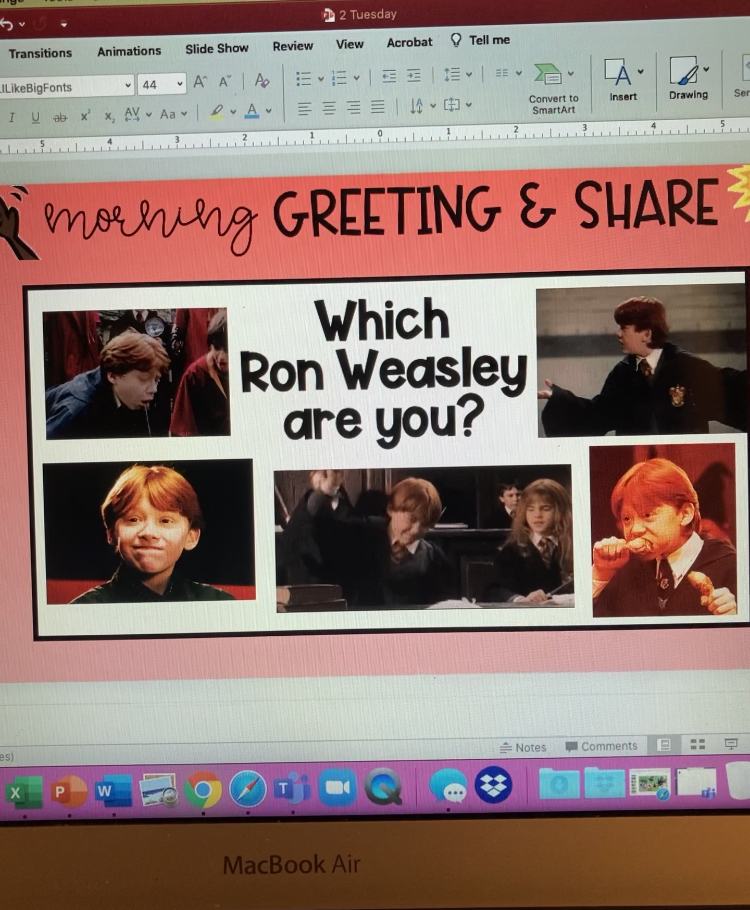
A Tuesday Tradition for our Greeting
This year has been no different in that respect, but with the added complication of nostalgia for practically everything from the “before times” as well. Yet, just like every other year before, this year it was only a matter of time before this class started to feel like my class. Over the past 14 weeks, my co-teacher and I have created an incredible little online community. I’ve had some of my favorite teaching moments, maybe ever, with this crew of kiddos. And in the last few weeks, in particular, virtual school has finally felt like school. 

On most days, the kiddos log into the programs we use for independent practice quickly and independently, and I am able to pull individuals into separate meetings for feedback or intervention. During small groups, I’ve tried a few different things, but have found ways to get students working on differentiated skills and even collaborating to solve problems. I’ve also created traditions, like the “Which ____ are you?” Greeting during Morning Meeting on Tuesdays (with gifs of popular characters) and our favorite Brain Breaks from UJU videos, which siblings and parents often join for. At the end of the day, when everyone unmutes to wave and there’s a chorus of byes, and “Have a great afternoon!” and “See you tomorrow!” it almost feels we’re together. 

On Monday, I will go back to school in person with a small cohort of kiddos. Friends, family, and colleagues have been asking “how are you feeling about it?” And my best answer right now is “I'm feeling it all.” I’m equal parts anxious and curious and nervous and excited and terrified. I don’t know if it will feel like school when we’re all in masks and the desks are spread out and we can’t gather on the carpet for a read-aloud. But I know that we have re-created school before, which gives me hope that we can do it again. I'm also reminding myself that it takes time.


September 26, 2020

Reflections

Six years ago, I left the only school I’d ever taught at and went to teach at a new school across the city. This new school had different terms of engagement, different expectations for students and teachers, different policies and routines. I went from being a veteran teacher with a lot of confidence, to feeling like I had no idea how to interact with students. 

At my new school, we weren’t allowed to sit in a circle for Morning Meeting, give first graders math workbooks, or administer individual reading assessments. We weren’t encouraged to provide differentiated reading choices, only the basal reader. I felt like all of the teaching tools I had acquired during my first seven years of teaching had been yanked away from me. As things got more difficult, I doubled down. I worked harder to re-create the systems I’d used in the past, to make my new classroom feel familiar, and to urge my administration to reconsider their policies. I started putting in even more hours than I typically did (which was a lot.) I went in early, left late, worked constantly at home. 

I lost count of how many times
I put this library back together.


My goal up to that point, had been to move into leadership within a year or two. During those first few months, I thought constantly about how I could excel in this teaching environment, while every challenge and set-back made me question if I was cut out for teaching or administration at all.  I was miserable and confused. I cried a lot. I truly believed, or wanted to believe, that if I put in more time and more effort, that things would get easier, but they didn’t. In fact, they got harder, and more things started to change: my co-teacher was pulled from classroom, my roster was switched, and I got less frequent support. By the middle of fall, I was exhausted and sick, looking at new jobs and new careers. 

Miraculously, I was pulled out of that situation by a call from my former school that a sudden vacancy had opened up in the fourth grade. I’d only ever taught early elementary, and the thought of working with older students made me nervous, but I barely had to think twice about accepting. I needed out. 

Day 1 in my first fourth grade classroom. 

In January, I started teaching fourth grade. It wasn’t easy, but this time, I didn’t let it consume me. I stopped focusing on the future. I wasn’t sure if I wanted to stay in fourth grade, or in teaching, but I decided I could survive until the end of the year. I stopped worrying about re-creating my old classroom environment; after all, this was a new grade for me. I didn’t assume I knew everything. Instead, I tried to pay attention to what worked and didn’t work with the kids in front of me. I didn’t try to innovate much with the curriculum, since I was only ever a few days ahead in my planning. I kept things simple. 

I continued to put in a lot of hours, but I also read, baked, and visited friends on the weekends. I started to re-prioritize my physical and emotional health. I let myself believe that I could get better, and I did. By the end of that year, I’d decided to stay in fourth grade for another year to continue learning and improving. 

One of my favorite student notes EVER.
In hindsight, I can see that one of the reasons I struggled so much at the new school was because I couldn’t let go of the way I had done things in the past. I didn’t think I could improve unless I was allowed to do things my old way. I knew that my way was better. It took me a long time to realize, however, that I hadn’t just been trying to hold on to a familiar way of teaching.

During the same time I was switching schools, I was also experiencing significant changes in my personal life. I’d moved out of the city and an apartment I loved, away from my friends and neighborhood. Looking back, I still believe that my way of teaching could have been better for me and my students at the new school, but now I wonder if that would have been enough for me. I wasn’t just trying to make my new classroom feel comfortable and familiar, I was trying to make my new life feel comfortable and familiar. 

The past four weeks have been some of the most challenging of my teaching career. I’ve been miserable and confused, I’ve cried a lot, and I’ve been letting it consume me. I’ve been struggling to try to make this new way of teaching (all virtual) feel like the old, familiar way. I've been putting in more hours than I have in a long time. But recently I realized, even if I could re-create my old classroom online (or in person), even if I could go back to the way I’ve taught and assessed students in the past, it wouldn’t be enough. 

Three devices now feels like a minimum.
Moving to a new house and a new school in the same year is not the same as teaching during a global pandemic, but the parallels aren't lost on me.  Working from home, in a makeshift office, with political unrest and the coronavirus always in the back of our minds, our personal lives as teachers are completely changed. No amount of “consistent routines” or “innovative lessons” will be enough to make this year feel comfortable and familiar. 

So instead, I’ve decided to stop focusing on the future. I don’t know if I want to stay in teaching like this, but I believe I can survive until the end of the year. I’m not going to worry about re-creating my old classroom environment; after all, this is new for me. I won’t assume I know everything.  Instead, I’m going to pay attention to what works and doesn’t work with the kids in front of me.  I'll remind myself of my own words from years ago, “beyond a point, another hour of lesson planning at 11pm, or spending another weekend rearranging the classroom yet again, or reading another article on behavior management techniques, won't ‘solve everything.’”

During my first year of teaching, my roommate would ask me to name 3 good things each day. Some days it was a challenge to come up with that many. It all seemed impossible. Yet, over time, it got easier to focus on the good moments. I have never taught virtually before, or in a hybrid environment, or through a global pandemic, but I have been a first-year teacher, and a teacher in a new grade, on a new team, and in a new school. I've had days when teaching has come as naturally as breathing and many more days when it has felt like it sapped all my energy, and then some. These days, teaching online seems impossible, but I'm trying to name 3 good things each day. Some days it may be a challenge to come up with that many, but I'll celebrate the days when I can.


March 19, 2020

True Teaching

A few weeks ago, before the craziness of "remote learning" even entered our minds, I had an experience that brought me back to what I love about teaching. I started to blog about it then, but, as always, got distracted by things that seemed more important at the moment. Well, one blessing of the current #coronaclosure is that all of those "important" things -- running errands, meetings, lesson planning -- are suddenly much less urgent. So, I'm trying to use my new-found free time to re-focus. I woke up leisurely (no alarms!), did a yoga workout in my basement, and now I'm drinking hot coffee on the couch, and spending some time writing. It would be much more relaxing if the world didn't feel like it was falling apart, but I'm trying to enjoy what I can.

So here is the story I started to share weeks ago.  Somehow it feels equally, and maybe even more, relevant now as I think about what teaching may look like in the weeks and months to come...

It was Closing Circle. My students were gathered around the perimeter of our carpet. One of my students had a picture in a frame, ready to share. She began by telling us about her grandmother, the special relationship they had and how much they had in common. Then she shared that she was worried about her grandmother, and her grandfather, because her grandfather was getting a kidney transplant.  Her grandmother was donating the kidney and so they were both having to stay in the hospital for a little while (I should pause here to note that I did not verify these facts with her family, so I'm not actually sure this was a real story, but it was what she shared with our class).

As soon as this student mentioned the hospital and surgery, and her grandfather's failing kidneys, another one of my students began to comment under his breath "Ew! Agh, I don't want to hear this!"  Then he started to make fake-vomit noises. Immediately, I sent to our "Safe Place" to take a break. He groaned and pouted, and stomped away to the Safe Place, while his classmate finished her story and shared the framed picture of herself, as a baby, with her mom, grandmother, and aunts.  When she was ready for questions and comments, some of my other students jumped in to share their concern and well-wishes. Then it was time for everyone to go to Art class. I hustled the other students out the classroom door, while instructing the kiddo in the Safe Place to stay put so we could talk after everyone left.

Once the classroom was quiet, I walked over to the kiddo in the Safe Place. He was still a little pouty, but mostly calm. I started, as I always try to when I send students to "take a break," by asking him if he knew why I'd sent him away from the class. He said, "no." Of course he doesn't, I thought, and I could have just jumped to reprimanding him for being rude while another classmate was speaking. For some reason, though, I took another tactic. "Do you know what kidneys are?" I asked. "Yes," he answered confidently, and pointed to his heel. I stifled a smile, "Nope, that's your achilles."

At this point, I shifted gears and invited him, and another one who had stayed behind from Art class to finish a math assignment, over to my computer.  I pulled up brainpop.com.  Side note: This is one of my favorite websites because I can always count on them to have kid-appropriate videos for nearly any topic that comes up in my classroom. Case in point, within days of COVID-19 outbreaks worldwide, BrainPop had a free video available about coronaviruses, which included tips for avoiding spread, getting information from reliable sources, managing anxiety, and supporting others without judgement.


On this particular day, I searched "kidneys" and, sure enough, found a short video on the urinary tract system. We began to watch and I paused a few times to answer questions or explain further. "Yes, your pee is in your body all the time." "Well, your bladder sends a message to your brain when you need to pee so that you don't have an accident." "Right, your kidneys help filter out the bad stuff from the air we breathe and food we eat."  It was evident, very quickly, that neither of these kiddos had ever learned much about how their bodies work.  They were genuine, curious, and fascinated as the video went on.

At the end, I turned to the little guy who had made fake-vomit noises 20-minutes earlier at the mention of surgery. "Do you understand now why your classmate was feeling scared that her grandfather's kidney weren't working?" He answered quietly, "He could die without kidneys because the bad stuff would be in his body." I nodded, then asked, "Do you understand why it might have been hurtful that you were pretending to get sick while she was sharing about her grandfather's kidney transplant?" He was silent for a long moment. Then he just said, "Oops."

I knew he got it. He didn't need a lecture or punishment. He understood why his behavior had been inappropriate, and that he should try to be more sensitive in the future. It was a beautiful moment.  After that, I walked him to Art class. That was it.

Kids, and adults, often appear rude, unkind, disrespectful, or hurtful, when really they are confused and un-informed. We can tell them to be more thoughtful or empathetic, but that's only part of the solution. We actually need to provide more information, to teach them.
Missing all of this.

This has been a challenging year for me, and I've found myself feeling disconnected and unmotivated more than I'd like, but this experience reminded me what I love about teaching... being able to provide information, ideas, and answers at the time they are needed most.  My favorite moments in teaching have always been when I've been able to follow the interests, questions, or curiosities of my students. I know I haven't been doing this well lately. I've let the pressure of looming state tests, evaluations, and demanding parents push me to plough through content and focus on assessing standards, rather than knowledge. I can do better. We all can.

As we move into a new phase of education, I am hoping that I can make the time, and find more creative ways, to truly teach my students, even if we won't be gathering around the perimeter of the carpet for awhile.

July 11, 2017

New Year...Same Goals?

It's hard to believe that I'm approaching my eleventh year of teaching, but here we are...

More things have changed than stayed the same across those years, but there are few things that have remained consistent. For one, I'm still at the same school!  For another, each year I have created a "School Year __ IDEAS" document for the next year. This is where I collect all the great ideas I have after I finish a unit (you know the ones: the things I don't get to or realize too late or attempt unsuccessfully). I usually include ideas for read-aloud books, new classroom activities, improved procedures, and other small things that just might make the next year run more smoothly than the last.

Over the summer and throughout the school year, I check my "IDEAS" document and incorporate those ideas in to my planning and teaching. Ideally, each year I have new ideas and set new goals... but, unfortunately, it doesn't always work out that way...

Firsties greeting each other with the "Butterfly Greeting"
A few years ago, when I was teaching first grade, I committed to maintaining consistency in my Morning Meeting.  I was coming off a year where I had strayed from the by-the-book RC (Responsive Classroom) Morning Meeting, opting instead for fewer community-building group activities, and more Calendar Math routines. While nothing huge was missing, I did feel like my classroom community was lacking something without the RC songs and games.  So that year I kept my commitment; we had a "true" Morning Meeting every single day, without exception.  Even when we had field trips, assemblies, or special events, we managed to do a quick greeting and read a short Morning Message. My focus on implementing Morning Meeting paid off; despite some very challenging behaviors that year, my kiddos could count on starting our day together every day.

As I'm looking at my "Next Year IDEAS" doc for this coming year, I find myself once again setting a goal to execute Morning Meeting with fidelity every day. How did this happen?  Frankly, we had Morning Meeting most days this past year... but, especially toward the end, I got lax. Some days we had a longer Morning Work, some days we jumped right into content, sometimes we came to the carpet just for announcements.  Sometimes I wasn't prepared and needed those extra ten minutes to set up the SMART board or organize some copies. Other times, the kiddos were calm and quiet, and I didn't want to upset the balance. Whatever the reasons, it didn't always happen, and I think our community felt the repercussions.

Of course, I'm well aware that Morning Meeting won't solve all the inevitable classroom challenges I'll face this year.  But I do know that being prepared for each day and maintaining consistency can truly change how a classroom operates.  We all reap the benefits when I'm ready to go for the day, there is a predictable routine from the moment students walk into the classroom, and we can make smooth transitions from one activity to the next. So this year, I'm re-committing to holding Morning Meeting, day-in and day-out.

Fourth Graders doing the "Hand Stack" greeting!

Now, I just need to figure out what grade I'm going to be teaching... 😁


June 27, 2017

Book Buddies

When I was in fourth grade, my class was "Book Buddies" with my brother's Kindergarten class. Reading with our Book Buddies was one my favorite activities!  I still remember how exciting it was to go down to the Kindergarten room, picture books in hand, and get to be the "big kid" reading to the "little kids."  My brother and one of his friends would sit on either side of me as I read to them.  I remember practicing how to remind them to sit quietly, listen, look at the pictures, point to sight words on the page... I guess I was a teacher even back then. 😂

Book Buddies is still one my favorite activities and now my fourth graders are the "big kids." Every other week, or so, we traipse down three flights of stairs to our little Book Buddies' classroom.  My wonderful colleague typically has her little guys spread out around the room so that it's easy for the buddies to find each other. Then the magic begins!

It's so fun to watch the kiddos bond over books; see the little kids look up to the bigger ones, and watch the big ones practice all their best reading and teaching skills. As the year progresses, we add other activities to our Book Buddy time, like reading outside, making crafts, Book Buddy Morning Meetings, picnics, and even field trips to the park.

Not every Book Buddy match is an ideal one, but it's been surprising how many of our Buddy pairs turn out to be perfect for each other -- patient, understanding, similarly quirky, and adorable. Taking advantage of these strong bonds, I frequently remind my fourth graders that the younger students are looking up to them and their choices.  When one of my kiddos is having a tough time, visiting their Book Buddy can be the best motivator. And for the younger set, they always have great cheerleaders in their Big Buddies -- whether they are sharing their newest drawing or showing off a new skill on the playground.

I'm so glad that my school encourages this type of cross-grade-level interaction. Through Book Buddies, I've seen some of my most reluctant readers gain confidence as they read to a younger student; and I know that even my most impulsive kiddos can show great empathy and tolerance when working with a struggling Pre-Ker. Year and year, I know that Book Buddies is one our kiddos' favorite activities. We may even have some future teachers in this group...

How cute are they?!

June 23, 2017

Answering Their Questions

"What will happen if Donald Trump starts a war with the Mexicans?"

This question was left on a Post-it on my desk by two fourth graders back in October, following a discussion about the impending presidential election between Hillary Clinton and Donald Trump. Although it was easy, among my liberal friends, to bemoan the fact that ten-year-olds were worrying about such a thing as a war with Mexico, I recognize now that this was an incredibly important question for them to be asking -- regardless of the specifics around this particularly polarizing election.

Being a citizen, we teach young people, means questioning our leaders, and considering the ramifications of policy decisions, and making choices. Yet too often, I think, we shut down exactly these types of questions from our students because they make us, the adults, uncomfortable. We don't want to upset parents or administrators; we don't want to get stuck in a political debate; we don't really know the answer ourselves.

Or we answer glibly or sarcastically, or with forced reassurance that everything will be okay. The danger of this is that our kiddos can't always tell the difference between sarcasm and honesty.  They learn that these questions have fast, firm answers --

"What will happen if...?"
"Nothing."
"It can't really happen."
"We won't let it happen."
"Don't worry."

The truth is there are no simple answers to this type of deep question. The truth is, also, that it's not a simple question. When I answered this specific question, in a conversation with my class later, I tried to explain that there is a process for declaring war -- that our military would take action and other countries would respond, that it could be scary and dangerous and people would die. I also explained that while our country has been in wars in the past, it's hard to know how another war would go, which is why it is a big deal to suggest that any country take this route to solve the problems it has with other countries.

It is difficult to find answers to questions about public policy without layering on my own political views and values -- and admittedly, I'm not always successful -- but I try. I try because I think my students deserve to hear an answer, even if it's imperfect. I try because I want them to know that I'm thinking about these things too. I try because if they never get an answer, they may stop asking. And we need our kids to keep asking questions.

We need to raise children who want to know what will happen if -- if we start a war, or if we cut healthcare, or if we raise taxes. We also need to raise children who aren't quick to decide if war is right or wrong, or healthcare is all or nothing, or taxes are fair or unfair. We need to raise the next generation to ask difficult questions of themselves and of their leaders. Then we need them to be able to ponder and petition, to concede and to compromise, to conclude and resolve, and then to reconsider.

And it starts with answering their questions.

January 5, 2017

Teaching On Stage

Teaching is often compared to other service professions -- like nurses and clergy -- and there are certainly similarities there.  Teachers work for the public (i.e. our students and their families). The results of our work are largely intangible, and while it can be very rewarding, it's often thankless work as well.  I've been thinking recently, though, about a different comparison I heard a few years ago. In many ways, the career most similar to teaching is acting.

Fourth grader teaching her Pre-K Book Buddy!
The preparation teachers go through before a lesson is similar to actors learning their lines.  We study and rehearse to ensure that we can deliver a teaching point precisely or present a math skill clearly.  We then perform our lessons for a critical audience and have to be ready to accept their feedback and tweak our performance for future lessons, innovating while teaching the same standard.  Like actors, we are often seen only as our final performance -- and most people never even know about the the hours of research for the role, the rehearsals, the costume adjustments, the staging, or the last minute script changes.

Like an actor in a play, teachers try to build a genuine connection with our audience while portraying a character. Stage actors, like teachers, have families, histories, and issues that they bring into their role. While this background makes us into the performers that we are, sometimes our personal lives don't mesh with our role.  I have days when I'm emotional or exhausted, yet when I step in front of my kiddos, I'm "on stage" -- I need to smile, speak calmly, and focus on the content I'm teaching, regardless of what's been happening behind the scenes.

I'm often reminded of this comparison when I'm overwhelmed by working late, stressful morning meetings, or personal issues.  The reality is that all teachers have good days and bad days, and children they click with and those they don't.  Being a "responsive teacher" means knowing that my students and I will all have days we don't feel like working our hardest or doing our best. It means knowing that my students' families and experiences are as important and inextricable from them, as mine are from me. I hope that, like a stage performer, my vulnerability, honesty, and life experience shine through in my performance and ultimately make me someone who my audience (students and parents) trusts, appreciates, and supports.

July 19, 2016

What are we teaching?

I love to find cute pins on Pinterest and pictures on Instagram, but I admit I get antsy when I see endless crafts and clipart on teacher blogs and Pinterest boards. I cringe when I see writing lessons that involve cutting and pasting text boxes or reading lessons that are mostly tracing and coloring.  As a former Pre-K teacher, I know how tempting it is to want every lesson to include a Pinterest-worthy product.  Yet activities that involve perfectly painted handprints, marks inside the lines, and carefully-cut collages often lack genuine instruction or real content.  I have to question "lessons" that are essentially cutting, pasting, and coloring -- what are they really teaching?

This goes back to one of the Guiding Principles of the Responsive Classroom approach: How children learn is as important as what they learn.  I'm critical of how I have my kiddos practice skills and demonstrate their understanding because I want to ensure that they are always learning and creating in authentic ways. While I incorporate art in my classroom, I try to avoid "craftivities" that don't actually allow students to be creative, use teamwork, or demonstrate genuine learning.

My kiddos share their thinking through jotting in the margins of books (or on post-its), journaling, debating, or discussing.  They learn how to write short stories, articles, and letters to share their individual ideas and interests.  They sketch and draw to visualize concepts and capture observations. Sure, they also cut and paste into their notebooks, but I try to make sure they are also thinking and writing independently.

Readers make notes and discuss their books.
Scientists record observations of what they find in nature (after a field trip).
Mathematicians understand fractions by creating visual representations.
Authors share favorites sections from their books.


November 15, 2014

Eleven Weeks

Eleven weeks. It took eleven weeks for my class this year to start feeling like my class. Eleven weeks to feel like I was finally really teaching, not just managing, handling, urging, or corralling.

A couple of weeks into the school year, I had seen a post on the Responsive Classroom website about the difference that the first Twelve Days can make with a new class.  I remember thinking, "we are so far from there! Will we ever get there?"  Week after week, I'd try to confer with my readers during Reading Workshop but would get distracted or interrupted by other kiddos.  At six weeks, I'd tried to open all of the activities that I'd planned for Word Study but found that my kiddos could not handle making choices. At the end of our second writing unit, I still had a number of writers who were struggling to produce complete stories. My kiddos were still regularly tattling, pushing, complaining, and teasing.

I kept hoping we'd get to a point when I could relax just a little during transitions or make it through a day without feeling like I'd lost control. So I scaled back, modified plans, did more modeling, had more discussions. I added tools to my readers' book bins to help them stay focused.  I limited the manipulative options during math to ensure the kiddos were able to use them appropriately.  I reviewed how to "Fill a Bucket" to encourage cooperation, patience, flexibility, and responsibility.

Finally, after eleven weeks, I was able to sit down next to one kiddo and talk about her reading while the others read quietly.  I was able to open all of the Word Study centers and the kiddos actually practiced their spelling words and worked together without the crying, whining, confusion, and throwing from a few weeks earlier.  I allowed the kiddos to select their own manipulatives during math and no one made them into weapons.

It finally feels like this class is my class and I'm no longer constantly reminiscing about previous classes.  My kiddos are doing more listening and helping than tattling and teasing.  I know that I will still have difficult mornings, afternoons, maybe even a whole day or week, but at least I've been able to experience some successes, which gives me hope for more. Phew!

September 21, 2014

Teaching is Hard

We are 4 weeks into the school year.  It hasn't been the easiest four weeks of my teaching career.  In fact, I've been feeling a little like I'm back in my first year when it seemed like a couple of kiddos were running the show.  It didn't seem to matter how much I planned, or how exciting our monthly theme was, or how I set up the classroom, these little guys had other ideas.  During that first year, I didn't have many tools in my toolbox for teaching an ordinary class of 4-year-olds, and even fewer skills to manage the extreme behaviors of a few students.

I hadn't yet read Gartrell's Power of Guidance, or Positive Discipline, or Teach Like a Champion.  I hadn't learned how to practice procedures until we got them right, or how to call kiddos back to the carpet when things go out of hand.  I hadn't figured out that a "teacher look" or a silent signal could refocus students during a lesson.  As a result, I spent most of that year in tears, feeling pretty hopeless about how each day would go.

But it's not my first year -- far from it -- and the difference is tangible as I look around my classroom.  I've set up clear expectations for entering the classroom, transitioning, working with partners, and reading independently.   I've taught the silent signals for "SHINE," "track the speaker," and "wait your turn," so I rarely need to interrupt my instruction for minor misbehavior.  I've created charts to show how I expect the kiddos to keep their seat pockets, book bins, and writing folders neat.

I now have a much larger arsenal of teaching tools, including the experience to know that some years are just like this.  During my first year, when it felt like nothing was going right, my roommate would insist that I find out at least 3 positive things that had happened each day.  I learned to focus on them, articulate them to myself, and try to foster more of them.  I know now that I won't always have to search for the good things, but I also know that there will always be at least a few good things even in the worst days.  The majority of my kiddos are falling into the procedures easily and getting used to the routines of the day, even though I am constantly on my toes to ensure that that the distracting and disruptive behavior of a couple of kiddos doesn't throw off an entire day.  I now know that, beyond a point, another hour of lesson planning at 11pm, or spending another weekend rearranging the classroom yet again, or reading another article on behavior management techniques, won't  "solve everything."

Because teaching is hard. It just is. It's like no other job in the world, and also a little like every job.  As a teacher, I often feel like part doctor, part lawyer, part parent, part police officer, part minister, part manager.  I don't think teaching ever gets "easier," but we become more comfortable with not knowing everything, not doing everything, and not being everything.

Sometimes on my worst days, I still get notes like this: "The Best Day of School" 

Rules in School

"Rule Creation" is one of the primary Classroom Practices within the Responsive Classroom Approach.  I've created class rules with almost all of my classes, but this year I took a slightly different approach.  Instead of jumping right into "what rules do we need?" I began by asking the kiddos to think about why we come to school and what we want to accomplish together.  We went through this process as adult learners at the Responsive Classroom Course this summer, and I found that it gave more purpose to the rule creation routine that I had had before.

I started on Day 2 by asking the firsties, "Why do we come to School?"  Their answers cracked me up; things like "to become a good adult," "to do plusses," and "to teach kids." After we had established our purpose for being at school in general, we thought about what types of school work we might do in First Grade. We made a list (I forgot to take a picture) of things like subtraction, art, field trips, and writing stories.  The kiddos created individual "hopes and dreams" for their first grade year based off of this list.

Then we got to the step of thinking about rules.  I reminded the kiddos about all of their goals and all the things that we hoped we would get to do together in first grade.  I asked them to think about how we would need to work together to reach those goals -- what rules would we need to be successful?  They came up with a very comprehensive list ;)

After we had a complete list we went through my favorite task of grouping the possible rules together.  I circled each of the topics in a different color and we came up with an all-encompassing rule to describe the topic.  For instance, "never hit," "tie your shoe laces," and "don't run" became "Keep Yourself and Others Safe."  "Don't lie," "don't bully" and "talk nicely" became "Use Kind Words."


During this process, I always guide the kiddos toward the rules that I want our class to use. For the last 3 years, I have ended up with the same 5 rules.  This year, we decided to make our 5th rule "Work Hard."  I'm still not sure if I'm thrilled with the switch because the "take care of your classroom and school" rule was so helpful in the past; however I like that now we have a rule that directs our cognitive work.  By now, the kiddos are getting comfortable with the language of the rules and I just love hearing them remind each other to "use kind words" and "follow directions."